This thing is HUGE. (That's what she said.) - Page 55 of 81 - ⚡️Kristen Kalp

Latest Blog Posts — Page 55

How I write books in 6 weeks or less. (i.e. fuck the plan)

I’m sure you’ll be shocked to learn that I don’t write books like most people. Other writers tell me they maintain a fairly slow and steady pace, chipping away a thousand words at a time for months upon months. Years, even. They are perfectly capable of submitting detailed outlines to editors and of making a legit Table of Contents they’ll stick to as their book unfolds.

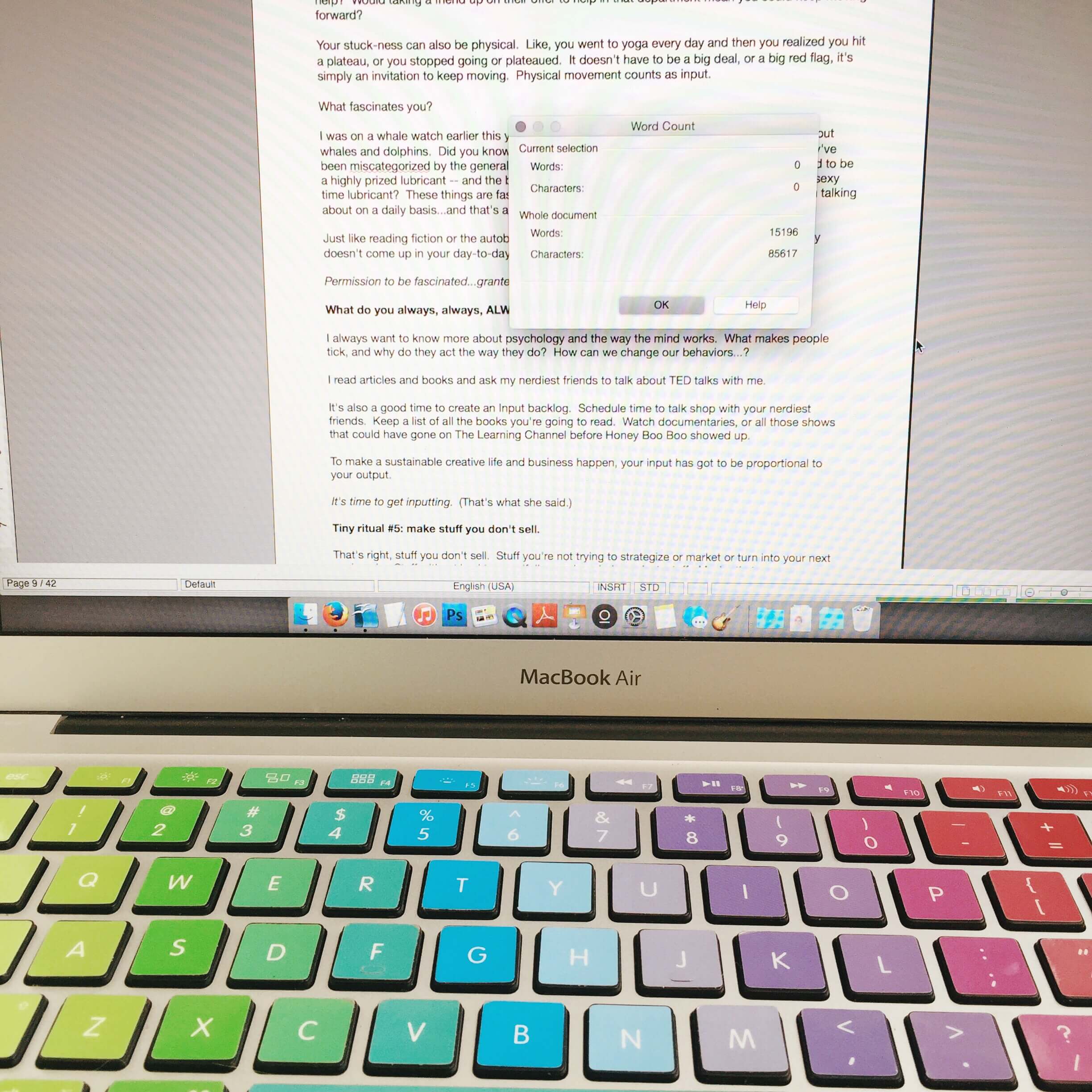
Not me. Here’s a behind-the-scenes look at the way I write, in all its glory. (Hint: there’s not really any glory. But there is a rainbow keyboard.)

First, I go hunting. I gather up all the scraps and bits and snippets I’ve written on my phone, on my laptop, and in my notebooks. Podcast pieces, class transcripts, and poems. Inspiring words I’ve written as responses to particularly moving e-mails.

All of it. Everything I’ve written since the last time I released a book. I let myself be overwhelmed by the immensity of it. That is, in some part, the point.

Then I edit. I cull. Ruthlessly and harshly, with a loving eye toward only the pieces that want to be a part of this particular project.

I weave my work like other people weave yarn, turning words into chapters, and chapters into the book.

It’s not logical or linear. (Currently, my Table of Contents is not in any way related to what I’ve written. It will be by the end, I promise.)

It’s entirely intuitive, and it’s not a bit like any class or system I’ve ever taken told me to do. I have a great deal of guilt, for example, about having edited 6,000 words the other day but ‘not doing enough’ because I didn’t also handle social media and the laundry and the grocery shopping. Yesterday, I did the social media and the grocery shopping, then felt guilty about having edited too quickly. Translation: my brain is still an asshole.

I weave quickly. My latest book went from 15,000 words to 30,000 in under a week.

It’s at 41,000 words and growing, as of this writing, and will keep on ticking upward as I add new pieces to fill gaps, make clearer points, and otherwise needle away at my own deadline.

Because I make my own deadline.

There’s no outer force pushing me to write — only my inner knowing that it’s time. This is the season to get it out, much like a pregnant woman knows when it’s time to push, only without forceps, and with way more alcohol.

I’ve made space for this to happen: no coaching calls, no Hermione D. Granger to walk and bathe and feed, no outstanding deadlines or commitments outside of my own.

I’m writing for me, for you, because the act of writing itself is one of the most joyful ones I know.

I still don’t know how it will turn out. I don’t know how much it will cost. I don’t know whether you’ll love it or hate it.

…and still I write.

Because it’s in me, it’s the thing that lives in my bones and that desperately wants to be out, away, and in the world.

I’m honoring my voice even as I don’t know what the fuck it’s doing or why the fuck it’s doing it.

So if you’ve ever felt like your process is TOO something — too slow, too fast, too linear, too logical, too uncertain, too messy, too vibrant, too fast-paced — there’s only one question to answer.

Are you doing the work? If you are, the process is perfect.

My process is a hybrid of labor pains and making space, like if a doula and a yoga teacher got together and had a happy hippie book baby, but they invited whales to come splash around on the beach so we would all know we’re on the right track.

Your process is just that…yours.

Fuck the plan, fuck the requirements and the endless planning, the labeling and trying to do it the “right” way.

YOUR way is the right way.

Relax, enjoy.

Here’s to your process, friend.

P.S.  Don’t drink the unicorn blood.  And put down that horcrux.

Everyone is not for everyone.

I’m at the wedding, plopped in an adirondack chair high in the yard, enjoying a cold beer while I watch folks in fancy dress mingle on the dock. The chatter of the other guests is all around me, a gentle fuzz of voices, when a woman stops in front of my seat.

“Who are you and why are you sitting all by yourself!?”

I blink. And laugh. “I’m the DJ’s girlfriend. I don’t know anyone.”

“Well, this is my daughter, Carli, and this is Grandma. Now you know someone.”

A blue-eyed old woman clutching red wine and smoking copiously plops down beside me. Carli, blond and light, proceeds to talk about Beverly Hills 90210 (“If my boyfriend is ever a drug dealer, I should dump him, right?”), her friends’ moms and dads (“They’re living together but she pays all his bills, that’s not right, is it?”), and her 10th birthday wishes (“Barbies, and a car for them. I would take pink or purple or white but not green”). We try the crab lollipops together. She pretends to like them. We laugh about all sorts of things. Then cocktail hour ends and whoosh! We’re relegated to separate tables.

Later, as dinner drags on, I feel a tug on my hand.

“Kristen I was thinking about dancing and I finished eating and…

Do you want to, like, hang out?”

That question, heartbreaking and tenuous all at once. So deeply vulnerable and childish (because of course I’ll say yes) but also, so adult. Asking for what you want.

It’s only by asking that I’ll say, “Yes, of course I would like to hang out with you, darling girl.”

We danced and danced and danced.

If you’re here, reading this, the work you do feels like an expression of your soul — or you’re trying to find the work that feels that way.

That work is inherently vulnerable. It’s exhausting and debilitating when people don’t like it or aren’t interested.

It’s scary to ask people to pay attention. It means tugging on the hands of people you like and asking, “Do you want to, like, hang out?”

Some will say no, or say they’re too busy, or beg off hanging out until later.

But others. They will dance with you until the wee hours of the morning. They will turn you around and around in the fading light, gleeful and lit up like so many fireworks. They will make all the asking worth it, and they’ll reward all that rejection with a heart that’s full to bursting.

Ask, friend.

Ask your clients to talk to you.

Ask them to come to your workshop or lecture or party or event or or seminar or phone meeting or class or photo shoot.

Ask them to dance with you, and I promise, the ones you’ll end up loving will answer with a resounding, “Yes. What took you so long to ask?”

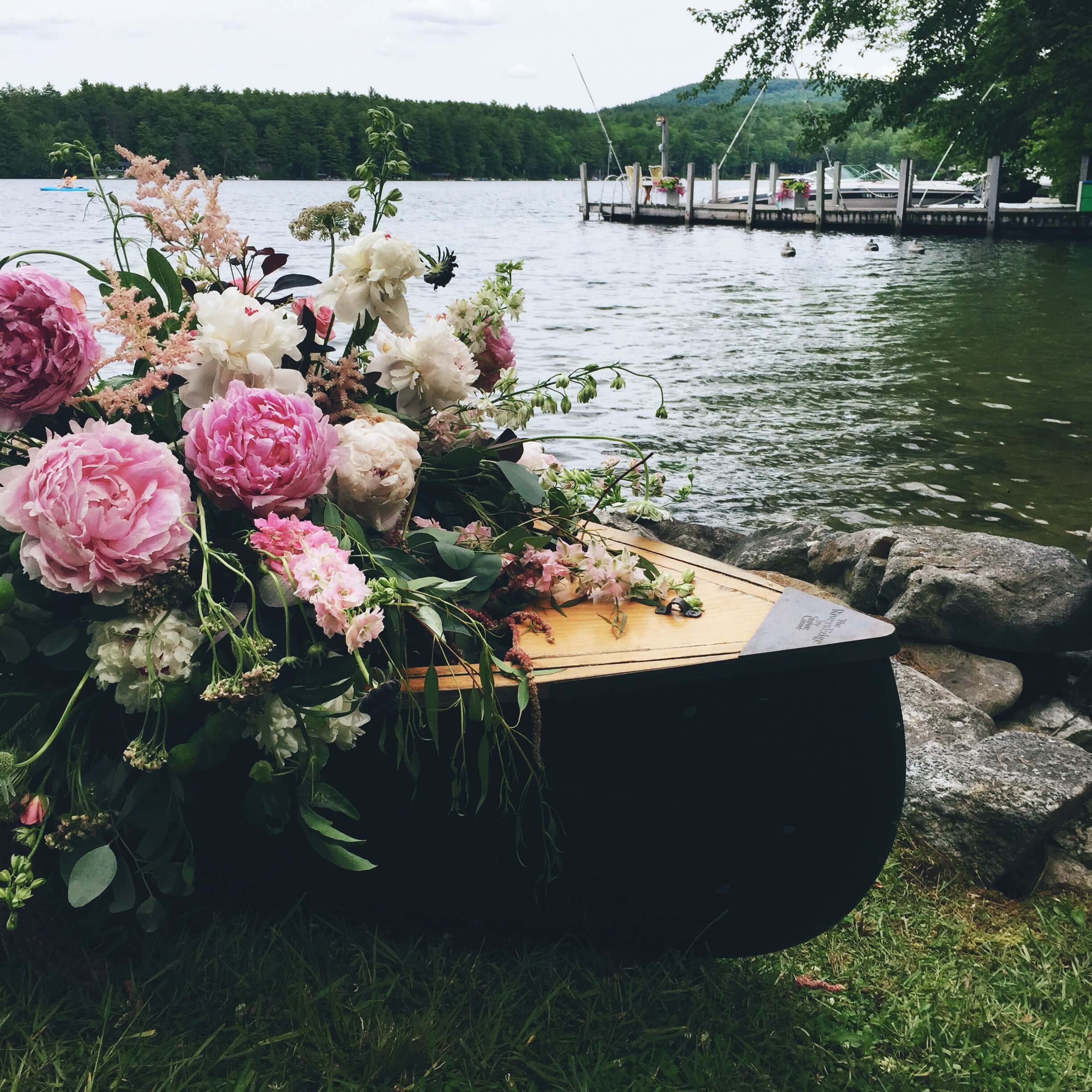
That’s only the beginning of today’s podcast, in which we talk all about finding your voice and inviting them onto your metaphorical dance floor.  (Also, in the kayak pictured?  Beer.  BEER BOAT AT A WEDDING.  Genius, isn’t it?)

P.S.  Why you don’t want to be failure-proof

How to not give a fuck.

One of the most common questions peeps ask me the first time we chat, whether in person or on the phone, is how I got to be me — this person who can drop the f-bomb and have pink hair and say the things no one else wants to say, and then expose deep parts of myself on the internets for all to see — without being crippled by fear or doubt or all the terrible things that could befall me for such vulnerability.

How do I do THAT?

It’s a process, but here’s the thing: I don’t give a fuck.

Each and every day, I have to guard the fucks I give, and worrying about what people think will steal my fucks like nothing else.

I have to help people be true to themselves, and write books and make podcasts and take care of my cats and dog and love my friends and keep my house clean and return my library books on time, which doesn’t leave much room for worrying about whether what I make offends people or makes them run away in horror.

If you’re ready to give zero fucks about what the world thinks of you while pursuing your work in the world, listen to today’s podcast.

It’s my favorite. This topic lights me up like no other.

Hugs,
K

P.S. When you’re learning to not give a fuck, you’ll need to learn to stop hiding.

I’m doing it! (Followed quickly by) I’m doing it wrong!

Turns out I’m doing this podcasting thing all wrong.

I started a podcast with only one episode. (Apparently I was supposed to have 3 to 8 to start.)

I’ve got no editorial calendar, because I talk about what my peeps are talking about, and I can’t know what they’ll be talking about in six to nine months. (PARTY FOUL. Big time.)

I’ve got short episodes with no editing, no intro or outro, no witty theme song, and no sponsors. (Only a voice and a mic? Holy fuck, SO WRONG.)

I don’t have the big fancy epic podcast hosting package that assures me I’ll be successful. I don’t pay $200-$300 an episode for a transcript because I write most of what I’m going to say out beforehand. (UGH NO TRANSCRIPT! FOR THE LOVE OF ALL THAT’S HOLY, HOW COULD YOU!?)

I don’t care about whether I’m featured in the New & Noteworthy section of iTunes. (Shit, I probably put myself in the wrong category, because there is no ‘Swears a lot, gives a shit, and helps you get in touch with the truest parts of yourself’ category anyway.)

I’M DOING IT ALL WRONG.

Every part of it, and there’s this Facebook group teeming with other people’s anxiety because they want to do it right.

1782 people committed to doing it right, with endless questions and concerns and ‘I want to start but I don’t know how and how did YOU start and I think I’ll start in a few weeks or months’ type questions.

One thousand, seven-hundred and eight-two people.

I quit that group today.

I dare you to quit the Facebook groups that make your stomach hurt, your palms sweat, or your heart race because they stress you out.

I dare you to do it all wrong.

To start. Even if you don’t know where it’s going.

Even if your gear is wrong.

Even if haven’t got a soundproof booth and a solid gold microphone that cost more than your car.

Start.

Even if you’re sure you’re not ready, or you’re sure you’re never going to be a hit on any sort of Apple platform.

Start now.

Just…start.

It’s okay to do it wrong. I’ll be cheering you on, too loudly and wearing mismatched jewelry, shouting, “I’m so proud of you,” but you won’t be able to hear me because my mic has got it all wrong, too. (I once laundered a mic by accident. ::shakes head at self::)

I dare you to ignore the well-meaning advice of strangers and just fucking dive all the way in, without infoproducts or the help of Facebook groups or the endless streams of articles you can read before you begin.

Make your stuff.

Do your work.

Start.

And if you haven’t yet, please subscribe to That’s What She Said in iTunes and listen for yourself. It’s all wrong, but lovely nonetheless.

Peeps in 46 countries are listening in, and your e-mails are moving my heart and my work in ways I couldn’t possibly have imagined. (Read: I cry when I think about how grateful I am to have your ear.)

P.S.  I also write books the wrong way.  (Six weeks, no book deal, pizza delivery all the way…)

Are you an empath?

I’m six, high on sugar and singing Jingle Bells with my church group, when we walk into the nursing home. She reaches out to touch my face and all of a sudden, tears stream down my cheeks. I look into her eyes and feel the weight of the sorrow that surrounds her like a shroud. It’s heavy and hopeless, a familiar cloak to the woman before me. For a handful of moments, I know the many facets of her sadness, even as she sits listening to the these well-meaning Christmas carolers singing in her cramped living room.

This is my earliest memory of feeling someone else’s feelings. We had visited private homes and nursing homes like this one on our caroling rounds. I wasn’t expecting this one to be any different. But then I met that old lady, reaching forward with such joy and transferring such sorrow to me.

The memory of it still brings tears to my eyes and feels a bit like I’m choking. It’s my first clear experience of being an empath.

Being an empath means you’re capable of feeling what another person is feeling in your body.

For each YES you answer, you’re one step closer to being an empath.

+ You find emotions contagious. Someone’s laughing, you’ll feel happy; someone’s crying, your own eyes are welling up with tears. You don’t have to know or love the person who’s emoting to catch their emotions.
+ You often feel overwhelmed in big box stores when they’re crowded. Give you an empty Target, and there’s no problem whatsoever — it’s not shopping for toilet paper that gets you, it’s shopping for toilet paper with hundreds of other people on a Sunday afternoon when all those people would rather be anywhere else.
+ You have trouble watching violent films or playing violent video games. They disturb you in ways you can’t quite articulate.
+ You hate certain commercials. Dammit, the aaaarms of the angel song makes you cry every time you hear it now. Same goes for the starving orphans in Africa commercials, and any wounded animal commercials…the emotional manipulation is off the charts, and you resent it. Big time.
+ You avoid watching the news. Local news, world news, nightly news…all of it. News drains you. You feel slightly guilty about failing to keep up with the state of the world, but it costs you too much energy.
+ You realize arguments take place on two levels: what’s being said, and the emotions that are being thrown around. An argument about whose turn it is to change the kitty litter can be innocuous, or it can be a deeply painful experience. All depends on the energy involved. This baffles the people you have conflicts with, since “they didn’t say anything that bad,” or “they didn’t even raise their voice.”
+ You’re used to people telling you things they’ve never told anyone before. It happens all the time. People naturally trust you and confide in you.
+ You can “feel” the truth as easily as others can feel that pen in their hands. It’s easy to tell when someone is lying, hiding the truth, or trying to manipulate a situation to his or her benefit.
+ You take on other people’s energy as your own, meaning you can feel the impact of a person’s presence even after they’ve left the room. The stronger the energy, the longer it takes for it to dissipate. This can be great if you’ve just met the Dalai Lama, or terrible if you’ve just run into a foreign dictator. (Like you do.)
+ You don’t have all these energy and emotional issues with animals, which is why you LOVE them. Give you a kitten or a dog or a monkey or a guinea pig and you’re so, so happy to be alive. Animals are your least complicated friends, and you love them for it.

Got 7 yes’s or more? Congrats! You’re an empath.

It is both a great gift and a massive liability. Get close to a person who’s having a great time, drunk or high or otherwise enjoying life, and you’ll also feel great. Let an old lady reach out to touch your face during an otherwise ordinary bout of Christmas caroling as a child and you’ll be crying in front of all your friends in no time.

I was flooded with great shame on the van ride back to church when our caroling finished. I had cried for no reason! I was supposed to be cheering people up! I didn’t even SING for her, and that was my job! (Even at six I took jobs seriously.)

Worse, everyone had seen me cry and now thought I was weird. I was already painfully shy. This made it worse.

Emotions are contagious. They’ve always been contagious in my world, like the common cold or the Great Thanksgiving Stomach Flu of 2002.

I’ve always been able to feel when someone is upset, anxious, nervous, tired, sad, angry, peaceful, happy, joyful, or embarrassed. Emotions are communicated to me as clearly as others might use sign language to tell stories or make funny faces to get another person giggling incessantly. They’re simple to dissect and quite easy to navigate. They’re familiar waters.

Other people freak out when someone cries or someone is busy having a tantrum or someone is off dancing in the corner for what appears to be no good reason. The older I get, the more easily I can feel the mirroring emotions in my body and use the information to decode a situation.

If you’ve ever been in the middle of shopping at a big box store and felt like you couldn’t breathe, like you were being squished from the inside, like you were being overwhelmed by a wave of uncomfortable and terrible emotions, or you were trapped with an incredible pain you couldn’t explain…you might be an empath.

To those who aren’t empaths, you’re a real weirdo. Like, “What do you mean you can’t shop at Target on the weekend?” Or “Why do you hate grocery shopping so much, it’s just…groceries?” You might have heard, “But you like concerts…so you’re okay with crowds. What’s the big deal?”

It’s a big deal because you can feel others’ emotions as your own.

This isn’t any more weird than being able to identify the leaves of an oak tree appropriately or knowing the recipe for three different pies without having to glance at an index card scribbled with instructions. You know things, so far down that you no longer remember how or where these abilities started.

Because you can feel others’ emotions as your own, you’re incredibly sensitive to changes in others’ moods, feelings, and energies. No one who’s about to cry around you can get away with the ol’ “I’m fine! I’m fine!” because you know better.

Very few people who are in a great deal of pain can hide it, because you’ll be feeling it as your own in some cases. I regularly ask Doey to take Ibuprofen because her chronic neck and back pain are so bad that they affect me when we’re together.

So…what do you do with this information? How do you view it as something more than a curse — because holy crap, the emotions most people are feeling aren’t usually sunshine and roses, especially while trolling around the local Wal-Mart?

First, acknowledge that it’s real. You feel others’ emotions.

You know things about what other people are feeling, both in their bodies and in their minds. You are keenly aware of changes in emotions and in mood. Even if a person were to be visually separated from you, you’d feel the same things. You’re not merely good at reading body language or facial expressions. Being an empath goes far beyond those skills.

You’re not crazy, though you might feel crazy.

You might feel like you’re at the mercy of the world, unable to control your own feelings. You’re especially prone to strong emotions overtaking you when you’re minding your own business, oblivious to your fellow humans until their emotions come creeping over to say “hello.” The homeless guy holding his dog tightly while napping can cause you to weep with overwhelming despair. The kid flitting around pretending to be a butterfly in the park can lift your heart higher than the top of the sliding board.

Those who aren’t empaths won’t understand why you’re so affected by the presence of other people who enter the room, how you’re so careful to manage the emotions of everyone you encounter as best you can, and why you’re sometimes given no choice but to hole up in a room by yourself until you can feel your own emotions again. (When your body seems to be going haywire with emotional information, sometimes this is the only option.)

Second, know that it gets better. The minute you realize that what you’re experiencing has a name and that you’re not a crazy-ass freakshow — that there are other humans like you, for whom emotions are contagious — you’re ready to start managing your gifts.

My sense is that you do one of two things when faced with your empathic nature.

Option one, you turtle. You notice an onslaught. You notice that you’re feeling all the feels. You quickly withdraw and allow the emotions to hit that hard shell you’ve built up. Safe in your shell, you can feel nothing but your own emotions.

Trouble is, that shell is heavy. And lugging it around is tiresome. When you DO come out, you feel disconnected from your fellow humans. It’s exhausting.

Option two, you deer. Okay, so ‘deer’ isn’t a verb, but whatever. You allow the emotions to hit you so hard that you end up spinning around like Bambi on ice. Your knees buckle, you feel overwhelmed. You laugh, you cry, you want to throw things, you feel like a victim of every human you encounter.

Trouble is, feeling like a victim is terrible. You don’t like feeling powerless, nor do you like wishing every human on the face of the Earth would vanish so you could have your emotions to yourself. It’s exhausting.

There is a third option, and one we’ll discuss at great length in the new Empaths, Inc. workshop: the porcupine.

You maintain your soft underbelly, but you also have defenses. You prepare your quills to do battle when you push yourself onto the subway, go through the lines at Target, or navigate a crowded coffee shop.

You let your quills relax and enjoy your true nature when you’re in the company of humans you love. You give strangers the benefit of the doubt, but protect yourself the moment they give you reason to believe they’re ticking emotional timebombs.

It’s not an easy balance, and you can easily shift from turtle to porcupine to deer in the course of a single day, but it gets much easier with practice.

Up next: how to feel the shit you’d rather avoid without gaining twelve pounds.